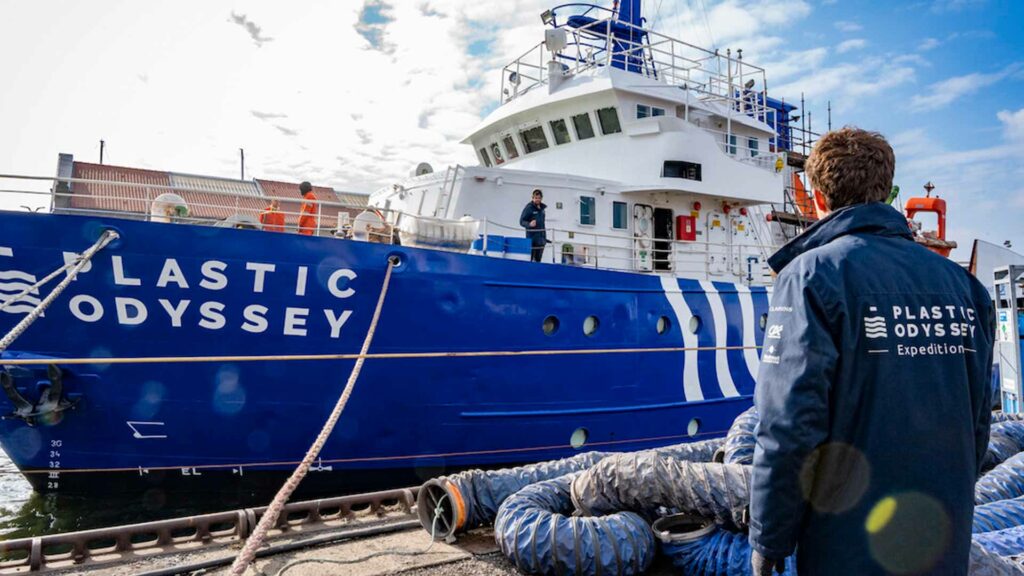
We have proven that remote marine cleanups are possible. Now we must prove they can scale. The world’s most biodiverse marine sanctuaries are accumulating plastic at alarming rates. Many are too remote, too logistically complex, and too costly to reach with conventional vessels. Our current ship was retrofitted for exploration. The next one is designed for restoration at scale.
Engineering the next generation of marine restoration
The current Plastic Odyssey vessel demonstrated that remote cleanups are possible. The next ship is designed to make them scalable, measurable, and repeatable.
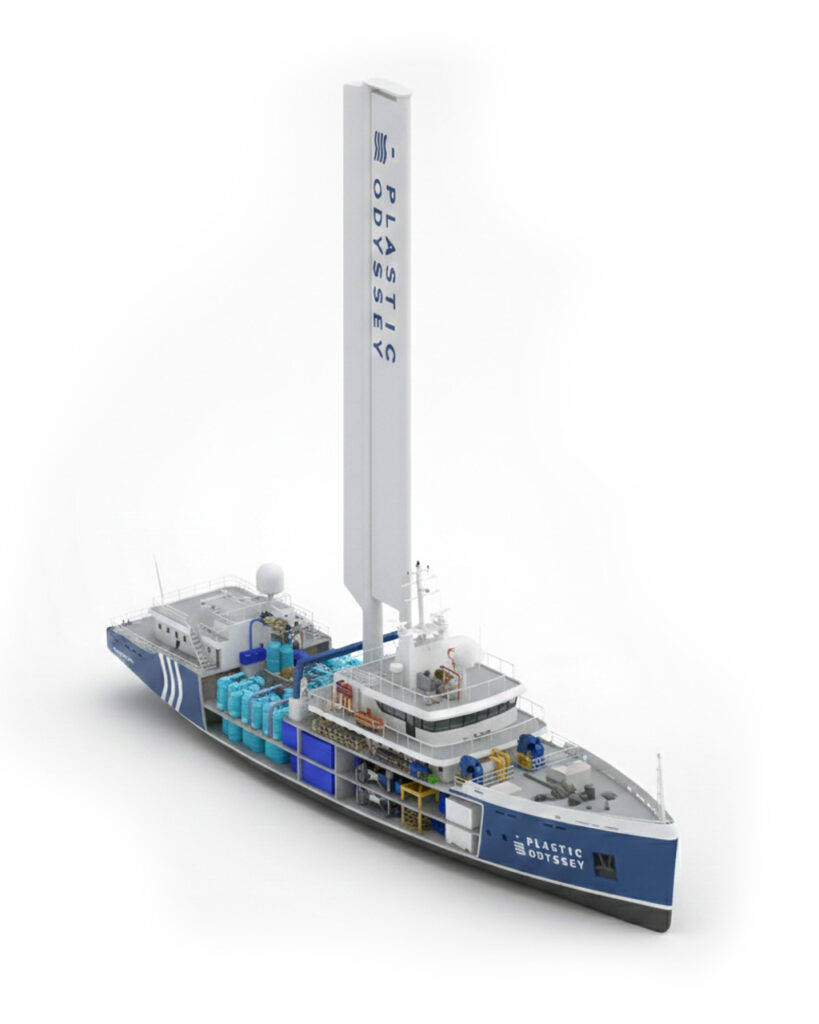
This future 60-meter sail-assisted vessel is conceived from the keel up as dedicated restoration infrastructure, combining cargo capacity, scientific capability, and marine robotics in a single integrated platform.
Built for Scale
Unlike the current retrofitted research vessel, the new ship is engineered specifically to:
Transport up to 250 metric tons of collected marine plastic per mission cycle
Operate as a true cargo platform capable of handling bulk debris
Sustain long-range missions in isolated marine sanctuaries
By integrating cargo design with field operations, the vessel enables large-volume removal in regions where logistics are traditionally the limiting factor.
Designed for Precision Operations
Restoration at scale requires more than transport. It requires accuracy. The vessel incorporates dedicated systems for:
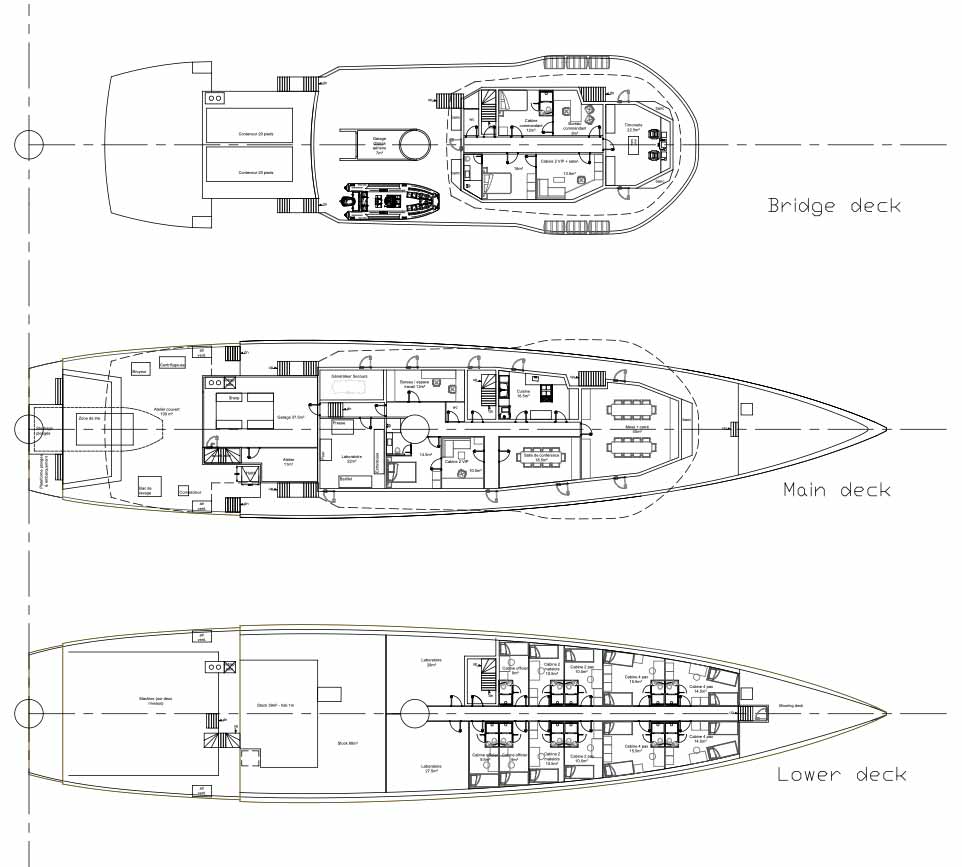
Deployment and recovery of underwater robotics and aerial drones
High-resolution mapping and debris assessment
Controlled sorting and material handling workflows
Diver-supported and robotics-assisted interventions
This configuration transforms the ship into an operational base capable of combining cleanup, monitoring, and site assessment within a single mission cycle.
A Floating Research Platform
The vessel includes integrated laboratory facilities to host multidisciplinary scientific teams. Onboard infrastructure allows for:
Sample collection and preliminary analysis
Environmental monitoring
Pre- and post-intervention ecosystem assessment
This enables restoration efforts to be documented rigorously and contributes to evidence-based protection strategies.
Low-Emission, Long-Range Navigation
The propulsion architecture prioritizes wind-assisted navigation supported by hybrid auxiliary systems and renewable energy integration.
This design reduces fuel dependency while preserving ocean-crossing capability and operational autonomy in remote regions.
From Mission to Infrastructure
This vessel marks a transition from proof of concept to structured restoration capability. It is the first step toward a future fleet of specialized ships capable of:
Accessing remote marine sanctuaries
Removing significant volumes of plastic debris
Supporting scientific research
Contributing to long-term ecosystem recovery
The objective is not simply to build a larger ship. It is to engineer a platform capable of redefining how large-scale marine restoration is executed.
Plastic Odyssey Fund is a California Nonprofit Public Benefit Corporation recognized as tax-exempt under Section 501(c)(3) of the U.S. Internal Revenue Code (EIN: 99-4899981). Contributions are tax-deductible for U.S. donors and support programs in the U.S. and abroad through affiliated Plastic Odyssey entities, in accordance with U.S. nonprofit law.